


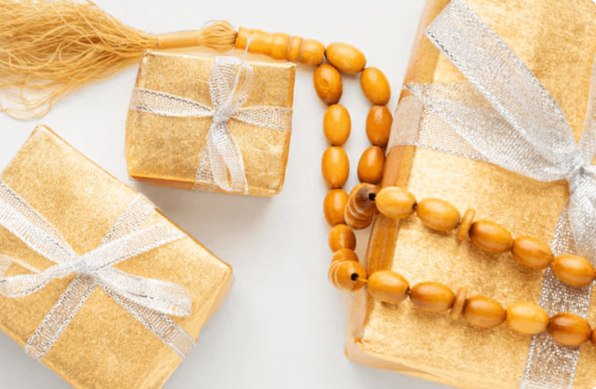
What is the Importance of Giving Gifts in Islam?
Gift-giving is something every culture practices, but in Islam, it carries a meaning that goes much deeper than a simple exchange of items. It is a tradition rooted in the Prophet’s (PBUH) life, tied to intention, and connected to how we treat the people around us.
Whether it is a date, a bottle of perfume, or a heartfelt note, the act of giving in Islam holds real spiritual weight. Let us break down why gifts matter so much in Islam and how this beautiful practice shapes relationships, faith, and community.
It is a Sunnah of the Prophet (PBUH)
The most important reason Muslims should give gifts is that the Prophet Muhammad (PBUH) did it, encouraged it, and spoke about it directly.
Abu Hurayra (RA) reported that the Prophet (PBUH) said:
“Give gifts, and you will love one another.”
This hadith alone tells us everything. The Prophet (PBUH) did not say to give expensive gifts or give only on special occasions. He simply said give, and love will follow.
Anas bin Malik (RA) also narrated that the Prophet (PBUH) never refused a gift of perfume. He accepted gifts with grace, gave in return, and modelled the kind of generosity he wanted his companions to carry forward.
Gifts Remove Negative Feelings Between People
We all have moments where relationships become strained – with a sibling, a neighbour, a colleague. Feelings of resentment or jealousy can quietly build up without anyone addressing them directly.
Gifts cut through that tension in a way that words sometimes cannot.
The Prophet (PBUH) said:
“Give presents to one another. Presents remove malice from the hearts.”
(Tirmidhi, 2130)
There is real wisdom here. When you give someone a gift, it sends a clear message: I am not holding anything against you. That gesture, even if small, can shift the entire tone of a relationship. It is harder to stay angry with someone who is being genuinely kind to you.
This is why Islam places such value on gift-giving as a means for keeping communities healthy and connected.
The Intention Behind the Gift Matters Most
In Islam, every action is judged by its intention. Giving gifts is no different.
Umar bin Khattab (RA) narrated that the Prophet (PBUH) said:
“Actions are only judged according to the intentions behind them.”
(Bukhari and Muslim)
A gift given to show off, to get something in return, or to impress people in a position of power is not the same as a gift given out of genuine care. Imam Ghazali explained this clearly when he said that whoever gives a gift with an eye toward some personal benefit is not truly giving. He is essentially making a transaction.
A small gift given sincerely is worth far more than an expensive one given to impress.
It Strengthens Family Bonds
Maintaining family ties (what Islam calls silat ar-rahim) is one of the most emphasised duties in the religion. And gift-giving is one of the most practical ways to keep those ties strong.
Life gets busy. Families spread out. Distance grows. But a small, thoughtful gift sent to a relative can keep that connection alive in a way that a text message sometimes cannot. It says: I thought of you. You are still important to me.
The Prophet (PBUH) also reminded us never to look down on any gift, no matter how simple it is. He said:
“O Muslim women! No one of you should consider insignificant a gift to give to her neighbour even if it is the trotters of a sheep.”
It Is an Act of Worship
This is something many people do not think about: when you give a gift with the right intention, it becomes an act of worship.
Islam does not separate the spiritual from the everyday. Going to the masjid is worship. Feeding your family is worship. And giving a gift to someone purely out of love and goodness is also worship.
Giving is an expression of gratitude for what Allah has already given you. And that gratitude, in turn, brings more blessings.
Giving to Non-Muslims Is Also Encouraged
A common question that comes up, especially for Muslims living in the West, is whether it is okay to give gifts to non-Muslim neighbours, colleagues, or family members.
The general position in Islam is that giving gifts to non-Muslims as an act of kindness and goodwill is praiseworthy. Allah says in the Quran:
“Allah does not forbid you to deal kindly and with full equity with those who do not fight you on account of your faith.”
The Prophet (PBUH) himself accepted gifts from non-Muslims, including Al-Muqawqis, the ruler of Egypt. Umar (RA) gave a garment to his polytheist brother. These examples show that kindness through giving is not limited to the Muslim community.
The key condition is that the gift should not be tied to celebrating beliefs that go against Islam. Outside of that, giving a neighbour a box of dates, sharing a meal, or offering a thoughtful item is a way to show the character of a Muslim and draw people closer to a positive image of Islam.
Charity and Gifts Are Different – But Both Matter
People sometimes mix up gifts and charity, but they serve different purposes in Islam.
Charity (Sadaqah and Zakat) is given to those in need, with the intention of seeking Allah’s pleasure and helping the less fortunate. It is not tied to any specific person and is not about honouring the recipient socially.
A gift, on the other hand, is given to someone you have a relationship with – a friend, a family member, a neighbour. The intention is to honour them, strengthen your bond, and express care.
Both are valuable. Both are encouraged. But they are not the same thing, and understanding the difference helps you practice both more thoughtfully.
How Riwaya Is Redefining Gift-Giving in the UK
For Muslims living in the UK, finding gifts that actually align with Islamic values has not always been easy. Most mainstream gift shops are not designed with Muslim buyers in mind, which makes it hard to find something meaningful, appropriate, and rooted in the tradition of the Sunnah.
That is where Riwaya comes in.
Riwaya is a premium Islamic marketplace built specifically for the Muslim community in the UK and beyond. It brings together hundreds of ethical and faith-based businesses selling Islamic products, from gift sets and Islamic books to everyday essentials, abayas, prayer items, and more.
What makes Riwaya different is the intention behind the platform. Every purchase supports Muslim businesses. A percentage of all sales goes to charitable causes. And the marketplace is designed to make it genuinely easy to find thoughtful, Islamically appropriate gifts for every occasion.
If you are looking to practice the Sunnah of gift-giving and want something that actually means something, Riwaya is built exactly for that need.